

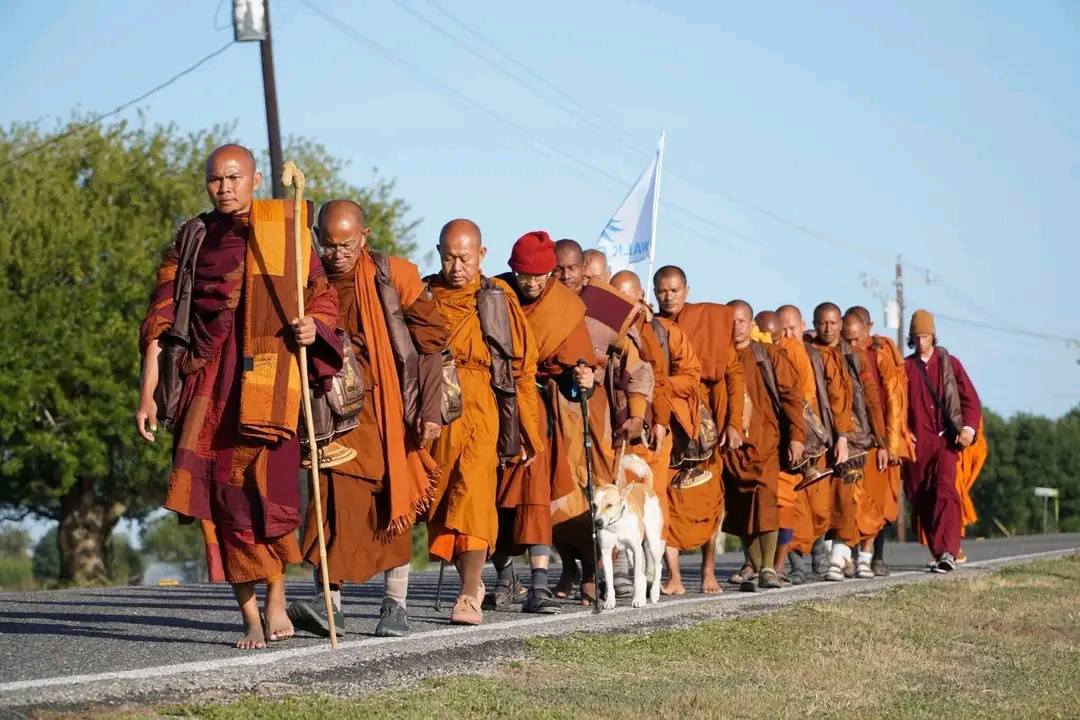
When twenty Buddhist monks stepped out onto a quiet highway in Texas, very few people knew that their journey would soon capture the hearts of millions across the United States. In an age dominated by political tension, endless noise, and social divisions, the simple image of monks walking barefoot along the road struck a nerve—calming, inspiring, and uniting people in ways no one had anticipated. Their 2,300-mile trek from Texas to Washington, D.C. was not planned as a grand public spectacle, yet it blossomed into one of the most uplifting human-interest stories of the year.
Their mission was rooted in peace, compassion, and prayer. But as their footsteps echoed from one state to another, their march transformed into something much larger—a symbol of perseverance, hope, and spiritual courage in troubled times. This is the story of how twenty monks, through humility and unwavering commitment, sparked a national wave of positivity simply by walking forward.
A Journey Begins in Silence
The trek began on a warm Texas morning. The monks assembled quietly, hands in prayer position, before taking their first steps. There were no reporters. No crowds. No drones overhead. Just the soft sound of cloth robes brushing against the wind and the rhythmic tapping of their walking staffs touching the road.
Their plan was straightforward: walk every day, meditate at sunrise and sunset, accept only basic food offerings from local supporters, and remain committed to non-violence and compassion throughout their journey.
The monks understood that walking such an enormous distance was both symbolic and physically demanding. Yet to them, this was not an act of endurance—it was an act of devotion. Their mission reflected a deeply rooted Buddhist tradition: journeying outward to cultivate peace inwardly, then sharing that peace with the world.
But as they took their first steps, none of them expected how profoundly their walk would resonate across America.
An Unexpected Spark of National Attention
The story began spreading in the most unlikely way. A passing truck driver recorded a short video of the monks walking in a straight line along the side of the highway. He posted it online with the caption: “Never seen anything like this in Texas. Who are they? Respect.” Within hours, the clip spread across social media.
People were drawn to the tranquility in the monks’ movements—the deliberate pace, the bowed heads, the sense of stillness amidst chaos. Soon, local news outlets began following the story. By the time the monks crossed into Louisiana, their journey had become a national topic.
What struck people most was not the distance, but the purpose: the monks were walking for peace, unity, compassion, and healing—a message many Americans felt they desperately needed.
Walking Through the Heart of America
As their journey carried them across states—Texas, Louisiana, Mississippi, Alabama, Georgia, and eventually northward—the monks left behind a trail of powerful impressions. They passed through small rural towns, busy cities, suburban stretches, and long isolated roads where cars rarely passed.
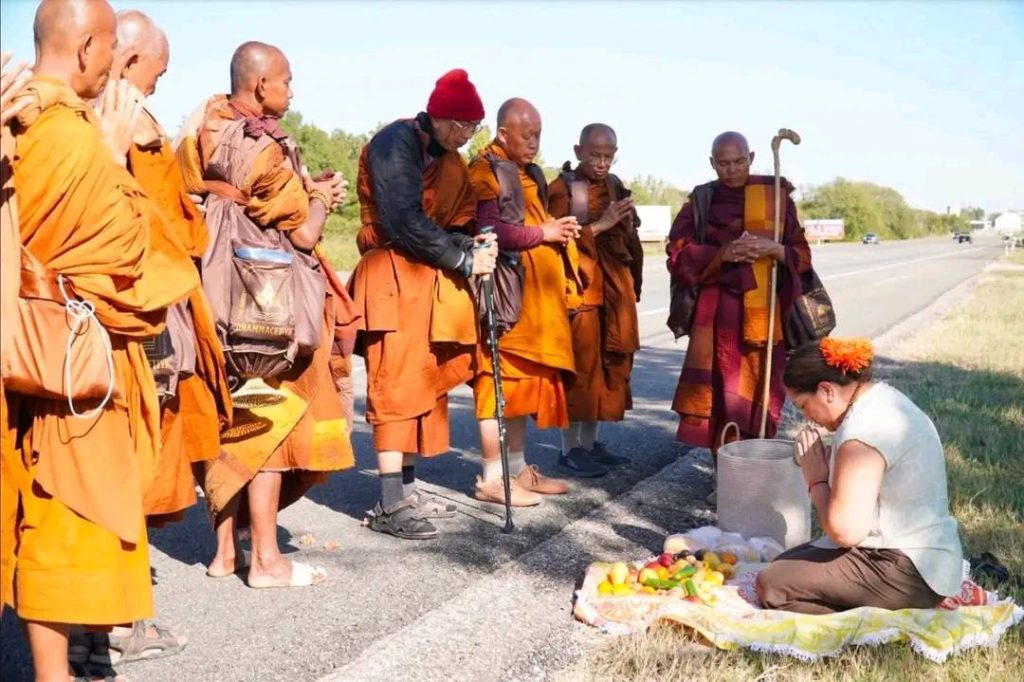
Everywhere they went, people came out to meet them. Families stood at the roadside holding water bottles. Farmers offered fruit. Parents brought their children to witness the walk. Churches, community centres, and even local police stations offered resting spots or meals.
Many who approached the monks admitted they didn’t fully understand Buddhism. Yet they felt connected to the monks’ message: kindness needs no translation.
In Mississippi, a grandmother stepped forward with tears in her eyes and told them, “I don’t know much about your faith, but I know this country needs more love. Thank you for walking for that.”
In Alabama, a group of veterans marched alongside them for several miles, saying the monks reminded them of the importance of peace after years of conflict.
In Georgia, schoolchildren drew signs that read “Keep Going!” and “Thank You for Peace.” The monks bowed in gratitude each time.
It became clear: the march was no longer simply a Buddhist pilgrimage. It had become a nationwide moment of reflection—an invitation for Americans to pause, breathe, and rediscover compassion.
The Discipline Behind Every Step
Although the monks’ walk looked serene, the physical challenge was immense. Walking 2,300 miles meant facing:
- blistering heat
- unexpected storms
- exhaustion
- listers and foot injuries
- hunger during long stretches
- open highways with fast-moving traffic
Yet they never complained. Their daily routine blended discipline with mindfulness:
- 4:30 AM – Morning meditation
- 5:30 AM – Light meal and chanting
- 6:30 AM – Begin walking
- 12:00 PM – Rest and receive food offerings
- 1:00 PM – Continue walking
- 5:00 PM – Stop for meditation
- 7:00 PM – Rest
Their commitment inspired many who followed them. People online wrote that watching the monks walk encouraged them to slow down, reconnect with their families, or practise kindness in their communities.
Physical endurance kept them on the road, but spiritual purpose guided every step.
Messages of Peace in Divided Times
As the monks travelled farther, news interviews began to highlight the purpose behind their journey. Their message was simple yet profound:
“We walk to cultivate peace in ourselves, in our communities, and in our country.”
In an era defined by political tension, economic stress, social frustration, and cultural division, their words landed softly but powerfully. They did not criticise any group, ideology, or individual. They did not engage in debate. Their mission was not political—it was human.
People from all backgrounds walked alongside them for short distances: Christians, Muslims, atheists, veterans, activists, students, and retirees. Many said that walking with the monks made them feel something they had not felt in a long time: calm.
A young man in Georgia said after joining them for a mile:
The Emotional Impact on Communities
Several communities along the route described the monks’ arrival as a turning point in their town’s atmosphere.
In a small Louisiana parish, residents organised a spontaneous peace gathering in a public park after the monks passed through. Neighbours who had barely spoken in years came together to pray, sing, and share food.
In Alabama, a local high school invited the monks to speak about compassion. One student, who had been struggling with anger and isolation, said the talk changed his outlook entirely.
In Georgia, a town known for political tensions held its first nonpartisan community dinner in years—sparked by conversations that began when residents came together to meet the monks.
The monks never asked for any of these events. Their walk simply awakened something in people: a desire for connection and togetherness.
The Challenges of the Road
Although the journey was uplifting, it was far from easy. The monks faced:
1. Physical danger
Busy highways posed constant risks. Several times, police officers escorted them through dangerous routes to ensure safety.
2. Weather extremes
Heavy rainstorms soaked their robes. Intense summer heat forced them to slow their pace. Cold nights tested their endurance.
3. Limited resources
The monks relied on donations for food and lodging. Some days brought generosity; other days brought only modest offerings.
4. Misunderstanding
Not everyone immediately understood the purpose of their walk. A few individuals initially expressed suspicion or confusion. But open conversations often transformed misunderstanding into respect.
Through each challenge, the monks remained calm—a living example of the peaceful resilience they preached.
Reaching Washington, D.C.: A Moment of Triumph
After months of walking, the day finally arrived. The monks approached Washington, D.C., their robes dusty, their feet weary, but their spirits bright.
Hundreds of supporters gathered to welcome them as they walked the final mile. People held signs reading:
- “Peace Starts with Us”
- “Thank You for Walking for America”
- “Compassion in Motion”
The atmosphere was emotional. Some cried. Some bowed. Some simply watched in silence. The monks, staying true to their devotion, bowed deeply in return.
They concluded their journey at a peaceful gathering near the National Mall, where they led a prayer for the nation:
- “May all beings be free from suffering.
- May all hearts find peace.
- May our country walk together in compassion.”
The crowd fell into a remarkable stillness—a unity rarely seen in the modern world.
The Legacy of the 2,300-Mile March
Even after the monks returned to their temple and resumed their daily lives, the impact of their journey continued to ripple across the nation.
1. A surge in local meditation groups
Many communities along the route began organising weekly meditation circles inspired by the monks’ teachings.
2. Renewed interest in interfaith dialogue
Churches, mosques, temples, and community centres started hosting events focused on unity, kindness, and shared humanity.
3. Increased focus on mindfulness
Schools, workplaces, and families reported adopting mindful practices, breathing exercises, or quiet moments of reflection after hearing the monks’ story.
4. A cultural reminder that kindness still resonates
In a world accustomed to conflict-driven headlines, the monks’ simple act of walking showed that people still crave peace—and respond deeply to it.
Why Their Walk Moved America
The monks’ trek was captivating not because of the distance, but because of what it represented.
A reminder of humility
While society often celebrates power and speed, the monks celebrated slowness, simplicity, and humility.
A message of hope
Their journey provided a quiet counterbalance to negativity, demonstrating that small acts of compassion can ignite meaningful change.
A shared human experience
Regardless of background, belief, or identity, people connected with the universal messages of peace and kindness.
A symbol of unity
Walking side-by-side with communities across the country created a rare feeling of togetherness—something Americans have been yearning for.
Conclusion: Footsteps That Changed Hearts
The 2,300-mile march from Texas to Washington, D.C. proved that even in a world overwhelmed by noise, conflict, and uncertainty, the simplest acts can hold the greatest power. Twenty Buddhist monks did not carry political banners, shout slogans, or demand attention. They walked—in silence, in prayer, in compassion. And somehow, those quiet footsteps reached millions. Their journey reminded America of something essential: peace is not a distant ideal, but a practice—one built step by step, moment by moment, person by person.
The monks have completed their trek, but the echoes of their message continue to resonate:
Walk gently. Walk kindly. Walk together.











Leave a Reply