

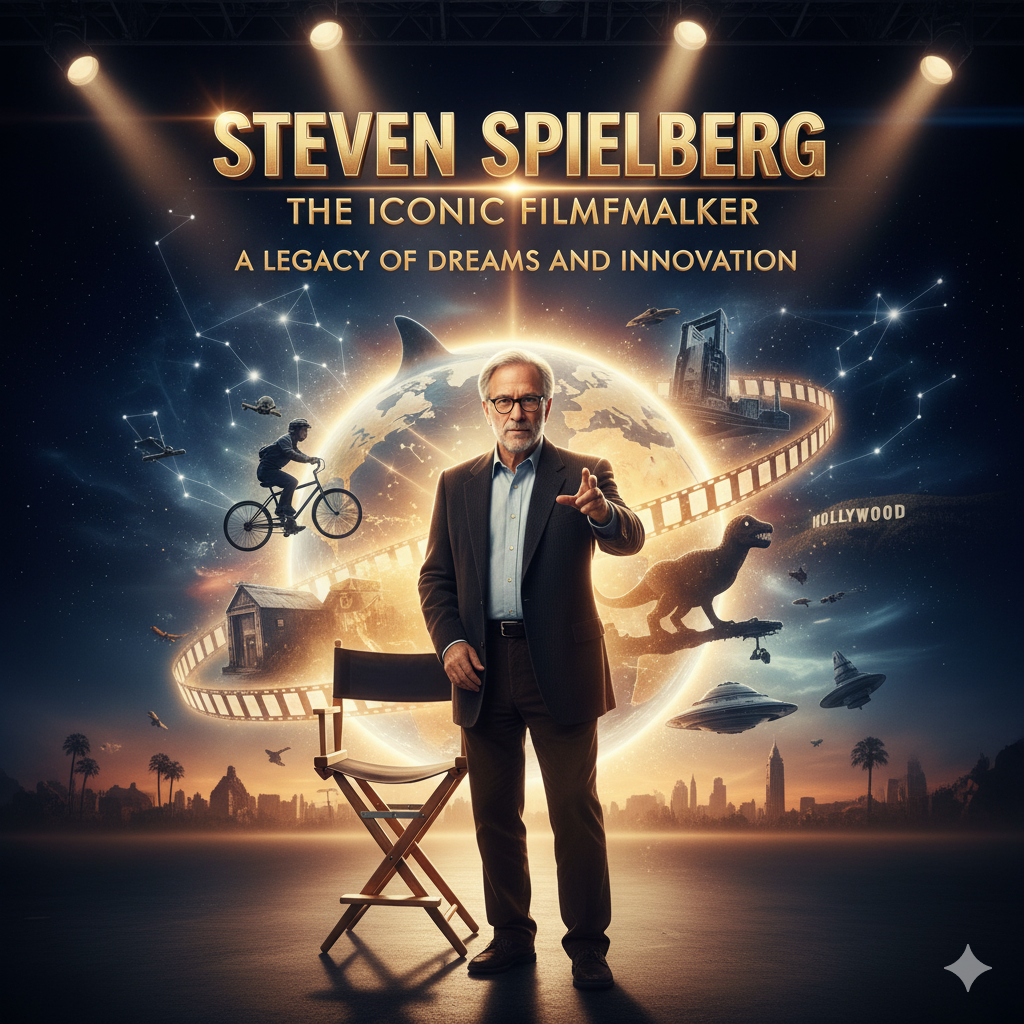
Steven Spielberg is one of the most influential and revered filmmakers in the history of cinema. His name has become synonymous with blockbuster entertainment, emotional storytelling, and groundbreaking filmmaking techniques. When discussing modern Hollywood, it is impossible to ignore the profound impact Steven Spielberg has had on every corner of the industry—from film production and storytelling to visual effects and even the business of Hollywood itself.
This article explores the life, legacy, contributions, and artistic brilliance of Steven Spielberg, explaining why he remains one of the greatest filmmakers the world has ever known.
Early Life: The Spark That Ignited a Legendary Career
Steven Allan Spielberg was born on December 18, 1946, in Cincinnati, Ohio. His childhood was filled with curiosity, creativity, and a fascination for adventure. Even at a young age, Steven Spielberg demonstrated a unique imagination and an ability to observe the world with depth and emotion.
Growing up, he often struggled in school and was bullied, but he found comfort and passion behind the camera. At twelve years old, Spielberg made his first amateur film using his father’s 8mm camera. The moment he looked through the lens, his life’s purpose crystallized.
By the time he was a teenager, Spielberg had already created several short films, each growing more sophisticated. His early works caught the attention of local communities, and he even earned small awards—an unusual achievement for someone so young. His creativity was unstoppable, and his vision was clear long before Hollywood noticed.
Breaking Into Hollywood: A Bold Beginning
Steven Spielberg did not enter Hollywood through the traditional gates. He famously began sneaking onto the Universal Studios lot, blending in with employees and attending meetings he wasn’t invited to. His courage paid off when he eventually secured an opportunity to direct a short film for Universal.
That film, “Amblin’,” created in 1968, became his breakthrough. The 26-minute masterpiece impressed studio executives so much that Spielberg was offered a contract to direct television episodes—making him one of the youngest directors ever hired by a major studio.
From there, he directed episodes for popular TV shows such as:
- Columbo
- Marcus Welby, M.D.
- Night Gallery
However, Steven Spielberg knew his future was in motion pictures, and it did not take long before Hollywood recognized his extraordinary talent.
The Rise of a Master: Spielberg’s Blockbuster Era
The 1970s marked the beginning of Spielberg’s unstoppable rise. His first major TV feature film, “Duel” (1971), became a cult classic and showcased his mastery of suspense and pacing. This caught Hollywood’s attention, opening doors to larger projects.
Jaws: The Movie That Changed Everything
In 1975, Spielberg released “Jaws,” a film that transformed Hollywood forever. The movie became the first true summer blockbuster, breaking box office records and establishing Spielberg as a visionary director.
- “Jaws” demonstrated:
- Unmatched suspense
- Masterful storytelling
- Innovative camera techniques
- A powerful understanding of audience psychology
Its success not only made Spielberg a household name but also changed the movie industry’s approach to marketing, wide releases, and blockbuster production.
Close Encounters of the Third Kind and E.T.: Emotion and Wonder
Following “Jaws,” Spielberg continued to push boundaries:
- “Close Encounters of the Third Kind” (1977) showcased his fascination with humanity’s relationship with the unknown.
- “E.T. the Extra-Terrestrial” (1982) became one of the highest-grossing films of all time, capturing the hearts of audiences worldwide with its emotional storytelling.
E.T. represented Spielberg’s genius at combining wonder, innocence, and emotional depth. Many critics consider it one of the greatest family films ever made.
Dominating the 1980s and 1990s: A Golden Age of Creativity
Throughout the 1980s and 1990s, Steven Spielberg displayed extraordinary versatility, mastering multiple genres.
Raiders of the Lost Ark and Indiana Jones
In collaboration with George Lucas, Spielberg created Indiana Jones, one of cinema’s most iconic characters. “Raiders of the Lost Ark” (1981) blended adventure, humor, and action with a style that influenced generations of filmmakers.
Jurassic Park: A New Era of Visual Effects
In 1993, Spielberg released “Jurassic Park,” a groundbreaking masterpiece that revolutionized visual effects. Using cutting-edge CGI, Spielberg brought dinosaurs to life with unprecedented realism, creating a benchmark for future blockbuster films.
Schindler’s List: A Powerful Masterpiece
That same year, he released “Schindler’s List,” a hauntingly beautiful film about the Holocaust. It won seven Academy Awards, including Best Picture and Best Director.
This film demonstrated Spielberg’s incredible emotional range—proving that he was not only a master of entertainment but also a storyteller capable of capturing the deepest human emotions.
Spielberg as a Producer: Building a Hollywood Empire
Beyond directing, Steven Spielberg co-founded DreamWorks SKG in 1994, along with Jeffrey Katzenberg and David Geffen. The studio became responsible for producing countless influential films, including:
- Shrek
- Gladiator
- American Beauty
- Saving Private Ryan
- War of the Worlds
DreamWorks solidified Spielberg’s role not just as a filmmaker, but as a powerful force in Hollywood business.
Spielberg’s Signature Style
Steven Spielberg’s filmmaking style is instantly recognizable. His work often includes:
1. Emotionally Driven Stories
Whether it’s a lost alien or a war hero, Spielberg ensures deep emotional connection.
2. Childlike Wonder
Many of his films capture innocence, curiosity, and discovery.
3. Masterful Camera Movement
He is known for smooth tracking shots, fast-paced action scenes, and tight emotional close-ups.
4. Collaboration with John Williams
Spielberg’s partnership with composer John Williams produced some of the most iconic soundtracks in film history.
5. Visual Storytelling
He prefers visuals over dialogue to reveal emotions and character growth.
Steven Spielberg’s Impact on Hollywood
Steven Spielberg’s contributions to cinema go far beyond directing. He revolutionized:
1. The Blockbuster Film Model
“Jaws” and “Jurassic Park” defined what successful blockbusters look like today.
2. Movie Ratings and Family Films
Spielberg helped create the PG-13 rating after the release of “Indiana Jones and the Temple of Doom.”
3. Visual Effects Development
His films inspired advancements in CGI, animatronics, and motion capture.
4. Historical Storytelling
Spielberg redefined historical filmmaking through works like Schindler’s List, Saving Private Ryan, and Munich.
5. The Film Industry’s Business Model
DreamWorks reshaped studio dynamics and distribution strategies.
Spielberg’s Awards and Recognition
Over his long career, Steven Spielberg has received:
- 3 Academy Awards
- Multiple Emmy Awards
- Golden Globes
- AFI Lifetime Achievement Award
- Presidential Medal of Freedom
However, Spielberg’s greatest achievement is the lasting influence he has had on global filmmaking.
Personal Life: The Man Behind the Camera
Despite his fame, Steven Spielberg is known for living a grounded, family-centered life. He is married to actress Kate Capshaw, with whom he has a blended family of seven children. Spielberg also embraces his Jewish identity, and many themes in his films reflect his cultural and emotional connection to his heritage.
His philanthropic efforts include donations to:
- Education
- Humanitarian causes
- Jewish organizations
- The Shoah Foundation, which he founded to preserve Holocaust testimony
Spielberg’s humanitarian work adds depth to the legacy he has built inside and outside Hollywood.
Spielberg’s Continued Influence in Modern Cinema
Even after decades in the industry, Steven Spielberg continues to direct and produce films that capture public attention. His recent films, such as The Post, Lincoln, and West Side Story, demonstrate his ability to adapt to modern storytelling while retaining his signature emotional depth.
His impact is visible in countless filmmakers today, including:
- J.J. Abrams
- Christopher Nolan
- Peter Jackson
- James Cameron
These directors frequently credit Spielberg as one of their greatest influences.
Why Steven Spielberg Remains a Legend
Steven Spielberg’s career is defined by:
- Boundless imagination
- Emotional intelligence
- Technical mastery
- Fearless storytelling
- A unique ability to speak to the human heart
Whether crafting an adventure, a war epic, or a touching family film, Spielberg’s work resonates with audiences of all ages and backgrounds.
He does not just create films—he creates cultural moments, emotional experiences, and unforgettable stories that last for generations.
Steven Spielberg’s Legacy Will Live Forever
Steven Spielberg is more than a filmmaker—he is a cinematic architect whose vision shaped modern film as we know it. His influence is woven into the foundation of Hollywood, inspiring countless storytellers and creators across the world.
From blockbusters like Jaws and Jurassic Park to masterpieces like Schindler’s List, Spielberg has consistently demonstrated unmatched creativity and emotional power. His legacy continues to grow with every new generation of film lovers who discover the magic of his storytelling.










Leave a Reply